


Coconut Oil: Properties, Processing Technologies, And Applications
Coconut oil is a vegetable fat extracted from the pulp or kernel of the coconut. It has a long history of culinary use and various applications in tropical regions. In recent years, with the global spread of healthy eating concepts and the growing demand for natural products, market interest in coconut oil has continued to rise. As a vegetable oil with a unique composition, coconut oil finds wide applications in both the food sector and industrial fields.
1. Composition and Properties of Coconut Oil
The most notable characteristic of coconut oil is its extremely high saturated fatty acid content, ranging from 80% to 90%, much higher than that of other common vegetable oils. Among these, lauric acid accounts for approximately 45% to 52%, making it the predominant characteristic fatty acid of coconut oil. Coconut oil is rich in medium-chain fatty acids (MCFA), which make up about 60% of its total fatty acid profile. These fatty acids are rapidly metabolised by the body and converted into energy, and they are less likely to be stored as body fat. The melting point of coconut oil is between 23 and 26 °C, so it is usually solid or semi-solid at room temperature. It also has high oxidative stability, with a shelf life of over 24 months.

# Coconut oil and raw material
2. Classification of Coconut Oil
Depending on the processing method and raw material used, coconut oil is mainly divided into three categories:
Crude coconut oil: obtained by pressing copra (dried coconut meat). It has a dark colour, high acidity, and poor taste; it is not suitable for direct consumption and requires further refining or is used for industrial purposes.
Refined coconut oil: produced from crude oil through processes such as degumming, neutralisation, bleaching, and deodorisation, which improve acidity and remove off-flavours, though some nutrients are lost during refining. The final product is colourless, odourless, and has a high smoke point, making it suitable for foodservice and industrial uses.
Virgin coconut oil: extracted by low-temperature mechanical pressing from fresh coconut meat, without chemical refining. It retains the natural aroma and nutrients of coconut, can be consumed directly or used in cooking, and is positioned in the premium market segment.
3. Processing Technologies for Coconut Oil
Industrial production of coconut oil mainly follows two routes: dry processing and wet processing. Our equipment is primarily designed for dry processing, which uses copra as the raw material and is the most prevalent industrial method; the oil content of dried coconut meat is about 60%. Depending on the production scale and investment budget, dry processing offers two configuration options:
Simple copra production line
The typical process flow is: copra crushing → screw oil press pressing → plate-and-frame filter filtration → semi-refining. The copra is crushed into uniform particles in a crusher, then fed into the screw oil press for pressing. The crude oil is filtered to remove impurities, and after semi-refining, the finished oil is obtained. This solution requires low equipment investment and a small footprint, making it suitable for small-scale start-up projects.

# Simple production line
Complete coconut oil production line
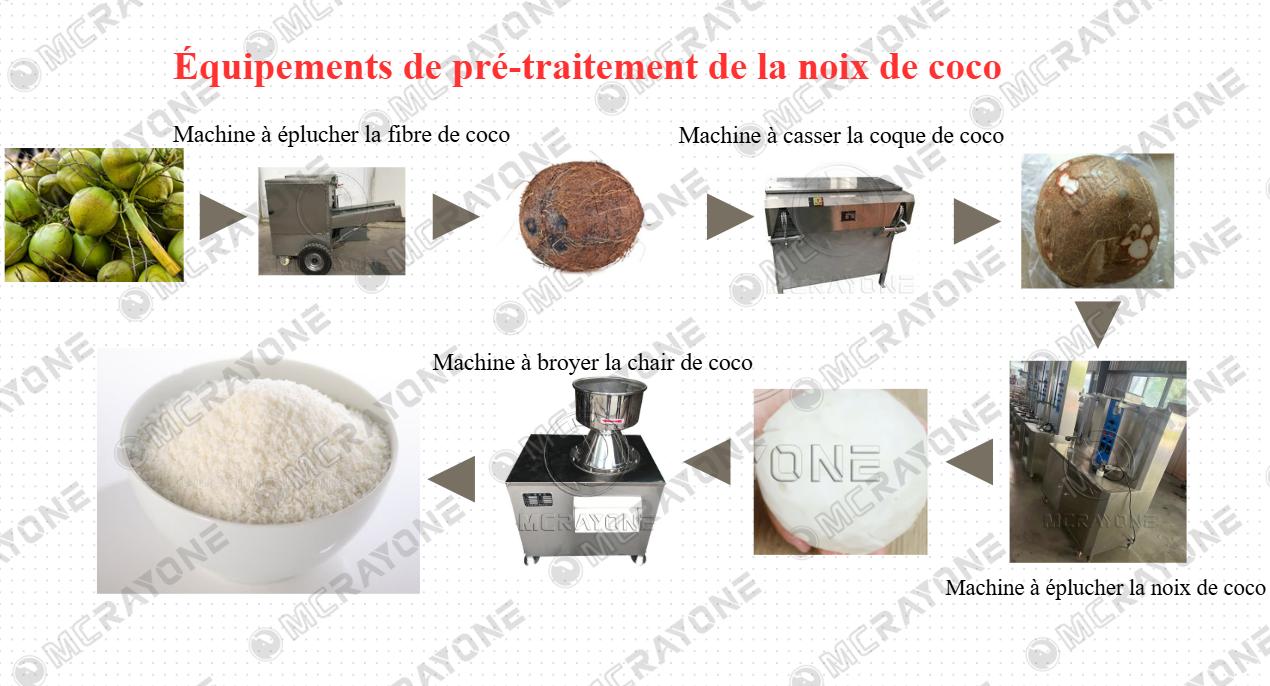
This includes more systematic pretreatment, pressing, and refining stages. The full process is: coconut peeling → shell crushing → coconut cutting in half → drying → hammer milling → cooking/conditioning → screw oil press pressing → filtration → oil clarification → refining. The prepared material is pressed in the screw oil press, and the crude oil then undergoes filtration, clarification, and refining to finally produce a finished oil that meets quality standards.
4. Application of the Screw Oil Press in Coconut Oil Processing
The screw oil press is the core equipment in industrial coconut oil production. It works by rotating a screw shaft that conveys the raw material from the feed end to the discharge end, creating progressively increasing pressure in the pressing chamber, which forces the oil out. Its advantages include continuous operation, high oil yield (residual oil in the coconut cake can be controlled at 7%-8%), and wide adaptability. Three key points should be noted during operation: during cooking/conditioning, the temperature should be controlled at 91-93 °C and the moisture reduced to 3%-4%; the particle size of crushed copra should be about 0.3 cm to ensure efficient extraction; and the crude oil must be filtered and clarified to remove impurities.
# Production line
5. Application Areas of Coconut Oil
Food uses: virgin coconut oil can be used in cooking, baking, and salad dressings; refined coconut oil, with its high smoke point, is suitable for deep-frying and high-temperature cooking.
Industrial uses: refined coconut oil is used in the production of margarine, shortening, soaps, and personal care products.
6. Global Coconut Oil Market Outlook
The global coconut oil market is on a steady growth trajectory. According to Mordor Intelligence data, the market size was approximately US$7.22 billion in 2025 and is projected to reach US$11.05 billion by 2031, with a compound annual growth rate (CAGR) of about 7.36%. The virgin coconut oil (VCO) segment shows even stronger growth, with a CAGR of 8.60% over the same period.
Regionally, the Asia-Pacific region is the world's core production and consumption area. The Philippines, Indonesia, and India together account for about 86% of global production, with the Philippines being the largest producer and exporter, holding approximately 49% of global export share. North America and Europe are important consumer markets, while the Middle East and Africa are also seeing steady growth.
In terms of production, global coconut oil output is estimated at about 3.5 million tonnes for the 2025/2026 season. On pricing, the premium of coconut oil over palm kernel oil has widened to a record US$1,000 per tonne, reflecting coconut oil's increasingly prominent scarcity value in the global oils and fats market.
In summary, the global coconut oil market shows robust supply and demand, with a clear growth trend. For the coconut oil processing equipment industry, this translates into steady equipment replacement demand and emerging market opportunities.
No Information


